Issue 02: Globe Trotter & Place Maker
We talk to Lisa Cameron about her life as a woman in construction.
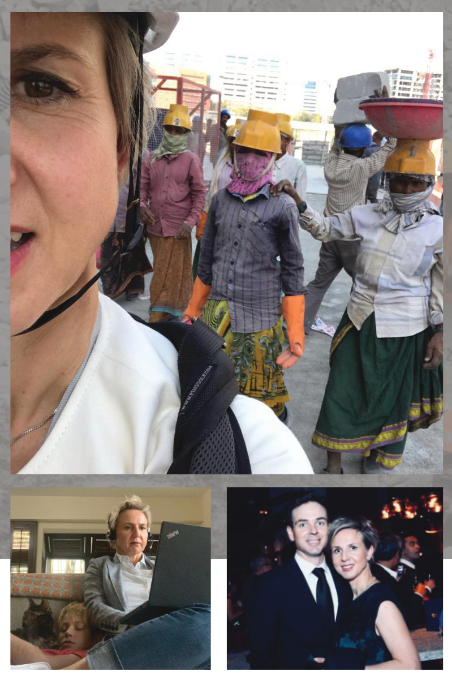
Lisa Cameron grew up in Australia before moving to Hong Kong. Having a degree in Architecture, a Masters in International Business and Economics, and confessing to have watched nearly everything on Netflix in recent months, Lisa has recently returned to university to undertake a Graduate Certificate in Supply Chain and Logistics Management. Lisa has negotiated multi million dollar contracts, worked on airports, data centers, green buildings, universities as well as designing highrise offices with famous architects. She is the recipient of many industry awards. Juggling the challenges of having a career whilst being a wife and mother, Lisa has spent the majority of her adult life working in the male dominated construction industry… and has absolutely loved it
I met Lisa a few years ago, in a different life, when she was leading the team that was redesigning our office space. Petite, elegant and with rockstar hair, we bonded over the design of female toilets, wellness rooms, and shoes, in a world used to men designing workplaces for men. So naturally, when it came to inspiring young girls on career possibilities, my thoughts turned to Lisa Cameron, to tell us about her life as a Woman in Construction.
IMTAC: Lisa, I’m beyond thrilled that you agreed to talk to IMTAC! I’ve been so inspired by watching you own your space and lead a room full of men.
When did you realise that you wanted to be an architect and construct buildings?
I grew up in a smallish town, where everybody knew everyone and family roles were quite traditional. Both my parents had gone to university and so it was something that I had always accepted I would do too. My mum was one of a handful of women in our town that had gone to uni, and even as a child, I could see the benefits of having a career.
I don’t think at 18 I knew exactly what I wanted to do, but what I did know was that I wanted to have a career and that it needed to be one I could travel abroad with. When I applied for university I listed Architecture, Urban Planning and some Science based medical degrees. I got offered Architecture, and so I accepted it. I used to draw a lot as a kid, build and design things, and help my dad when he worked on home improvement projects. I inherited my mom’s creativity and expressiveness and my dad’s mathematics and engineering bent, and Architecture is a good blend of both! The best thing about an Architecture career is the more you travel and experience life and understand people, the better you can design for them. It’s also a window into the past, old buildings are an insight into how people lived, worked, how society operated, and I find that really fascinating.
How did you land your first job in construction?
My first big role was on a team building an airport. Of the 250+ members of the team, there were only eight women on the site, and only two of those (of which I was one) were on the professional team. It was a fantastic time in the industry; a time when there were more roles than qualified people. I had entered the workforce after graduating with honours and running my own design practice, but the architecture firms I interviewed with couldn’t get past the fact that I was a newly single mum. I remember them asking what I would do if my children fell ill. I was viewed as a risky hire and was unsuccessful despite getting shortlisted many times. I was lucky that the construction industry at the time was taking everyone they could get, and so after interviewing successfully with just one firm, my career in construction began.
Who supported you most on your journey?
I credit my mother for a lot of my independence, but I am sure that pretty much everyone around me as I grew up infused me with the themes that I continue to hold as core beliefs. I have had some of the most unlikely individuals as sponsors. Gruff older men that were tough as nails, sun weathered from years on site, and others that have probably never picked up a tool in their lives, calm, intelligent with wisdom and a way that could provide you with absolute clarity when you needed it. For where I am today, I have to credit my husband, he knows how much my career means to me. Doing what I do would be impossible if my husband wasn’t up for the ride. I also think it’s important to have a strong sense of who you are deep down, in that quiet moment, that no one knows about but you.
What are the challenges women face in construction?
I remember the first time I walked onto a site for a new role, and the foreman politely suggested I walk back out of the gates for my own safety, as if I had wandered in by mistake. The change to his facial expression was priceless when I informed him that I wasn’t lost, I was just looking for my site office. As it turned out, there was a flood of phone calls made shortly after, because they did not allow for any female toilet facilities on the site. Though the statistics of women in Construction have hovered around 10% or less for the last decade, times have changed. The industry is more professional, with more governance and focus on health and safety, and increasing use of technology, than when I started.
What are the opportunities for women in Construction?
I think the breadth of professions that it encompasses actually makes it the perfect place for a woman to have a career. In fact, there NEEDS to be more women in the Built Environment.
When you have a whole industry tasked with designing and building for society, determining how we use space and how we experience a city, diverse contributions are absolutely necessary.
When architects talk about their designs, they don’t focus on the concrete, the engineering, they focus on how it works, what it will feel like, how it will address some form of problem or enhance an outcome. Construction isn’t just about building spaces, it’s actually about placemaking, where just one half of the population won’t be able to get it right for the whole of society. I would love more women to join the Construction Industry. With the changes in technology, with VR, supply chain, and contracting methods there’s a whole lot of career choices for women to pursue. And whilst I may have traded my steel caps for heels, I do miss wearing that fluro vest and my hard hat, and so if rolling up your sleeves and getting stuff done is for you, then so is a career in construction.
What would you tell your younger self?
There was a lack of female mentors when I began my career, and so I think I would definitely tell my younger self it’s OK to be different, to not fit in – certainly never apologize for that. In fact, it can be an advantage. When I look back on those times in my life when I smashed it out of the park, it wasn’t because I had my act together. Sometimes, I just didn’t have any other choice other than to go for it. I’ve taken roles that everyone ran away from, and done really well because of it
On a personal front, I think I overplanned my life, what I wanted to do and by when. For most of your life, you will perform the role of daughter, perhaps wife or mother, and so I wish someone had told me to take more time to be just myself. My first marriage at a young age didn’t work out, but I am happily married now with four great kids. I know that I haven’t always had a healthy balance because of the amount of time or focus I have given my career. I think you can save yourself a lot of heartache if you learn from the mistakes of others, so even now I am still learning, and have decided to spend this next chapter investing my time where it really counts, and rebalance the time I have with my family.