Issue 02: Helping Disadvantaged Women
Helping Disadvantaged Women
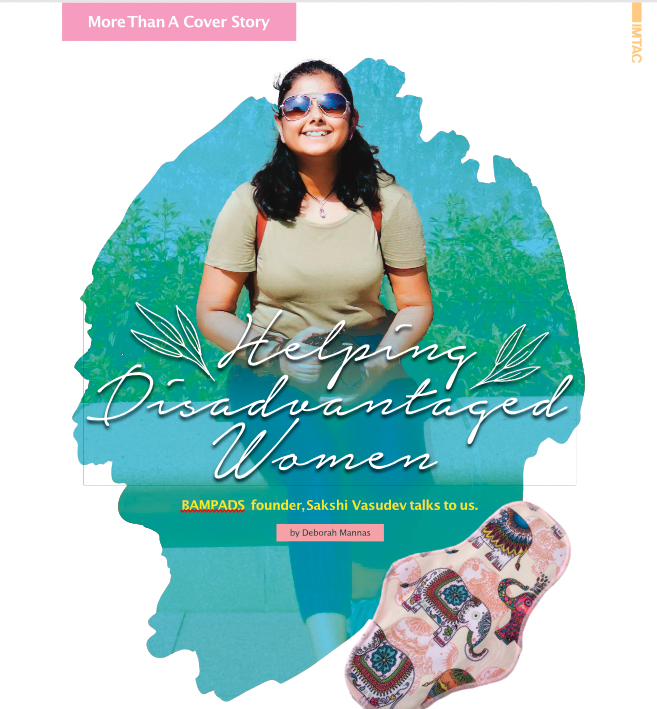
A year ago, I facilitated a workshop to help HK school kids channel their emotions into song, in a Kids4Kids program called “Powered By Youth”. Sakshi was one of the leaders of the school kids in my workshop, and I was impressed by her spirit, passion and talent.
We stayed in touch and when I started IMTAC, she was one of the first girls I got in touch with. At the young age of 18, her business idea, BAMPADS was approved by the Kids4Kids Action for a Cause program.
Deborah Mannas is conversing with Sakshi Vasudev.
I asked Sakshi to talk about BAMPADS and what inspires her.
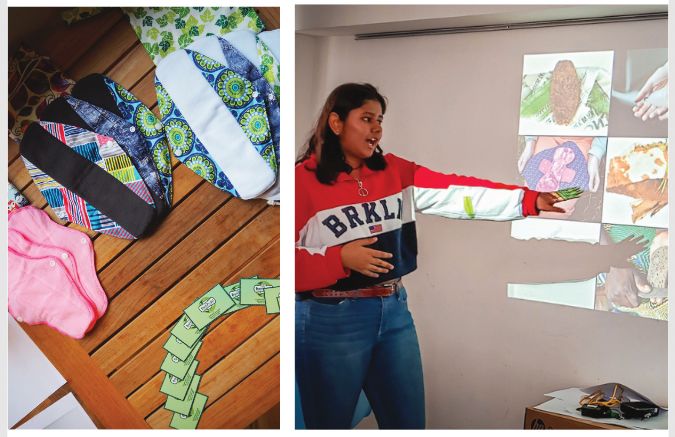
IMTAC: Sakshi can you tell us about yourself, what you are doing now and what you are passionate about? I turn 19 this year and am currently studying in City University of Hong Kong. I am a feminist and a period rights activist. I founded BamPads! in 2019 with the help from my family, especially my dad. In our culture, it is taboo to talk about periods, but I hope to raise awareness on the health, environment and economical benefit that reusable cloth pads provide. BamPads! is a social enterprise designed to empower women through education on sustainable periods and to market reusable pads for comfort, the environment, and those in need. BamPads! is actually an abbreviation of bamboo pads, which is one of our signature products.
Did you feel any expectations put on you because you were a girl, growing up?
I feel really lucky to have had parents, who supported my two sisters and I in whatever we did. They never put any expectations on us, whether at school or with our social life. My parents taught us right from wrong, and never really stressed about academic excellence. They just wanted me to do my best in whatever I did.
What were your best subjects in school and why?
My best subjects were definitely Music and German. I’ve enjoyed singing and performing since I was about six years old. Singing allows me to express myself through music and words, encouraging people to listen to the message more attentively. I have been rejected many times at singing competitions but I kept improving myself and my voice. Interestingly, I was never really interested in learning languages, but I learned German in high school and got a scholarship for a 3-week trip to Germany to enhance my German, which fueled my passion for languages. I can currently speak six languages.
Did you ever feel there were some things you couldn’t discuss, growing up?
There were a lot of things I was afraid to ask about, such as dating, or hanging out with guys (even just as friends) because I knew that my mother would disapprove. So I would secretly arrange for us to meet when I was out (this was when I was around 17 years old). Sometimes, topics like menstruation also felt like a taboo when touched upon in public or with friends. Even when we talked about periods, it was either in hushed voices or in code.
What’s your advice to other girls regarding discussing taboo subjects?
Do not be afraid to talk about these subjects with someone you trust. It is not weird or disgusting, but absolutely normal. I personally know how it feels to talk about taboo subjects with my parents. We have the tendency to avoid these subjects in conversations with them, but that’s okay. If you have friends or someone you look up to, you can always ask them questions or just talk to them!
What future do you see for girls in Asia? India?
With the problem of period poverty coming to light, many countries are trying hard to facilitate access to sanitary products and facilities for girls in Asia. They have started to realize that such necessities are crucial for the continuation of their education, and thus, promoting gender equality. Before there were many restrictions for girls in India such as child marriage, restricting menstruating girls from school premises and many more. But I believe the future is bright for girls and women as many are now are seeing the problematic reality of traditional practices, and stepping up to fight for equal rights to education.
Affordable, reusable menstrual products are not only a step towards liberating women from the stigma of menstruation in developing countries, but it’s also great for the environment the world over. Thank you for being part of this work Sakshi, and for sharing your story with IMTAC.
To learn more about BamPads, visit their website: www.bampads.com/our-story/